Project Report --- Increase in income of the Cooperative Twongere Umusaruro / Munyaga through milling activities
Introduction
The project "Increase in Income of the Cooperative Twongere Umusaruro / Munyaga through Milling Activities" was implemented by Réseau Culturel Sangwa with financial support from the Melania Foundation to strengthen the economic empowerment of women in Rwamagana District, Rwanda. The initiative focused on improving the cooperative's income through milling activities while enhancing members' capacities in cooperative management, entrepreneurship, financial literacy, savings, and access to credit.
The project sought not only to increase the income of the cooperative members but also to promote financial inclusion, encourage knowledge sharing within the community, and strengthen women's participation in local economic development. While some economic targets were affected by increased market competition, the project achieved important outcomes in women's empowerment, cooperative management, and community engagement, benefiting both direct participants and the wider community.
Goals, activities and results achieved after implementing the project
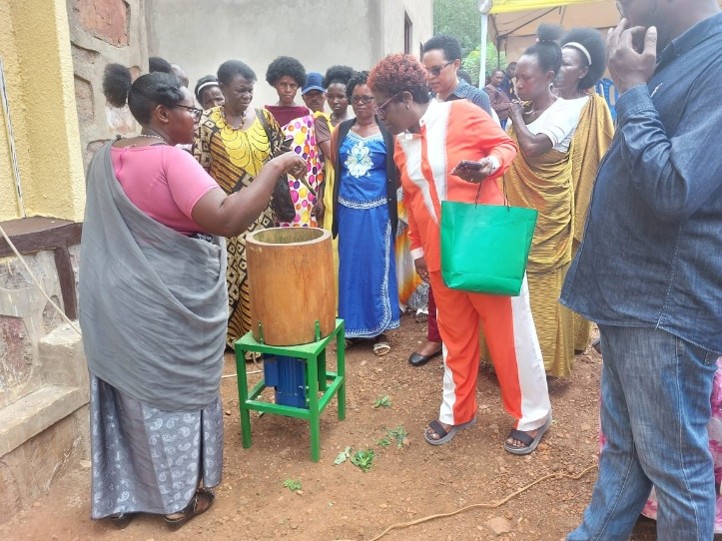
Cooperative members benefited from training in cooperative management, entrepreneurship, savings, and credit. These trainings strengthened their knowledge of economic activity management, financial planning, and cooperative operations, enabling them to improve their capacity to collectively manage the equipment and the income generated.
- The knowledge acquired was shared with other women in the surrounding communities, encouraging them to establish savings and credit groups within their respective communities.
- Approximately twenty women from the Twongere Umusaruro Munyaga Cooperative gained greater self-confidence, enabling them to seek external loans and initiate their own income-generating activities.
- Trust and cooperation between spouses were strengthened, as legally married women obtained their husbands’ consent and signatures to access credit facilities.
- Eighty percent (80%) of the women members of the Twongere Umusaruro Munyaga Cooperative opened their own bank accounts, a practice that had previously not been common among them.
- The achievements of the project were highly appreciated by the authorities of Rwamagana District, who consider the cooperative a model for the socio-economic development of the community.
- The implementation of the project, “Increase in Income of the Cooperative ‘Twongere Umusaruro / Munyaga through Milling Activities,” enabled Réseau Culturel Sangwa to significantly strengthen its interventions in Rwamagana District. Through this initiative, the organization was able to implement actions that addressed the needs of women and the local community while consolidating its presence within the intervention area.
- Financial support from the Melania Foundation represented an important opportunity for Réseau Culturel Sangwa to further pursue its mission and increase its impact for the benefit of the communities it serves. This partnership also enhanced the visibility and credibility of Réseau Culturel Sangwa among local stakeholders. As a result, Rwamagana District issued the Organization a Certificate of collaboration, a document required annually by the Rwanda Governance Board (RGB) for local NGOs.
Goals not achieved and reasons
The main objective of significantly increasing the income of the women who were the direct beneficiaries of the project was not fully achieved, reaching only 62% of the target. The income generated through the milling activities remained below the initial projections.
This situation was primarily due to the establishment of several competing mills in the same area after the project had commenced. The increased competition significantly reduced the number of customers expected to use the cooperative’s milling services and, consequently, the revenue generated by the project.
Furthermore, it had been anticipated that the income generated by the mill would enable the cooperative to purchase larger quantities of products for storage, processing, and marketing at a higher added value.
However, the stocks of cassava, maize, and sorghum acquired using revenue from the milling activities remained limited as a result of the competition described above. Consequently, the cooperative was unable to expand its value-added processing and marketing activities to the extent originally planned.
Numbers of women or girls that benefited from the outcomes of this project
The project results reached a total of 786 women,
distributed as follows:
- 26 direct women beneficiaries who directly participated in and benefited from the project activities.
- 260 women reached within the beneficiaries’ communities, with each direct beneficiary sharing information about the cooperative’s activities and the knowledge gained through the trainings with approximately ten women in her immediate surroundings.
- 304 people including 218 women and girls targeted by one of cooperative members who lead a Village and participate in 2 savings groups, and 500 women reached through other savings and credit groups, based on an average of 25 women per savings group associated with each of the 20 women who actively participated in and promoted these groups within their communities.
Overall, the project’s impact extended beyond the direct beneficiaries, contributing to the dissemination of knowledge, the promotion of savings and credit practices, and the strengthening of women’s economic empowerment within the wider community.
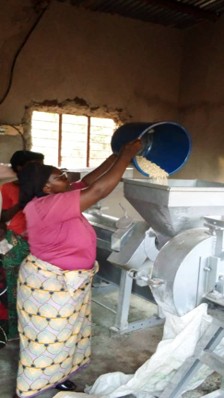
Mediatrice in maize
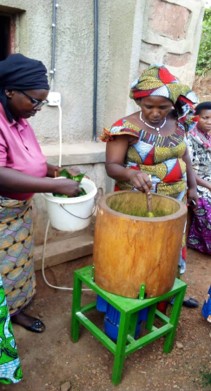
Cassava leaves grinding
0 Comments